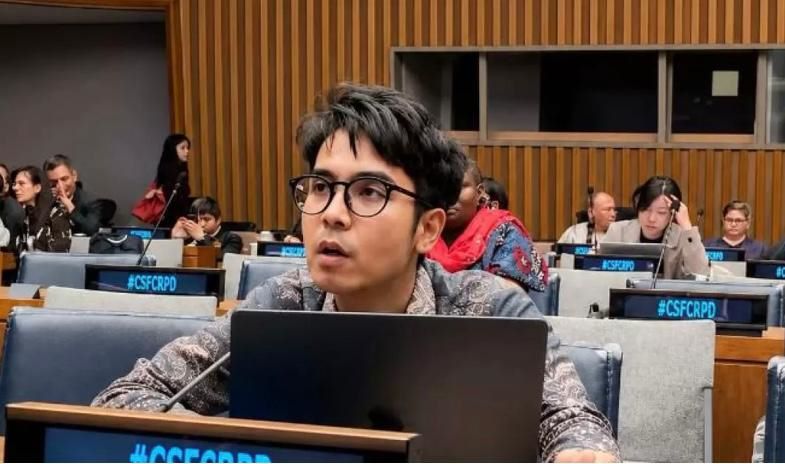
New York – Agus Hasan Hidayat, founder of the Revolution and Community Education for Social Inclusion Indonesia (REMISI), was a panelist at Roundtable 1 at the 19th Conference of States Parties (COSP) to the Convention on the Rights of Persons with Disabilities (CRPD), held at UN Headquarters in New York, USA, from June 9-11, 2026.
A written statement from REMISI on Wednesday (June 10) stated that in the session titled “Creating a World Free from Exploitation, Violence, and Abuse for All Persons with Disabilities,” held on June 10, 2026, Agus, representing REMISI and Indonesia, voiced the importance of eliminating discrimination and violence against persons with psychosocial disabilities.
He also advocated for the recognition of psychosocial disabilities as part of human diversity that must be respected, protected, and their rights fulfilled.
Agus’ presence as a panelist placed the perspective of people with psychosocial disabilities from Indonesia in one of the most important international forums discussing the implementation of the Convention on the Rights of Persons with Disabilities at the global level.
Meanwhile, the Conference of States Parties (COSP) is an annual forum of states parties to the Convention on the Rights of Persons with Disabilities, bringing together governments, organizations of persons with disabilities, civil society, international institutions, and various stakeholders from around the world to discuss the implementation of the rights of people with disabilities.
In addition to serving as a panelist at Roundtable 1, Agus also appeared as a panelist at a side event titled “Centering Youth and Gender Diverse Communities of Persons with Psychosocial Disabilities in the Deinstitutionalization Agenda.”
In his presentation, Agus highlighted the various challenges still faced by people with psychosocial disabilities, ranging from stigma, a culture of cynicism, paternalistic approaches, discrimination, and various forms of violence that often occur due to mental health conditions.
According to Agus, many people with psychosocial disabilities still lack equal opportunities to participate in social and economic life, or in decision-making that affects their lives.
“What we are fighting for is the elimination of all forms of discrimination and violence based on a person’s mental condition. Psychosocial disabilities must be accepted as part of human diversity, which deserves respect, their rights fulfilled, and space for meaningful participation,” said Agus.
He also emphasized the importance of strengthening deinstitutionalization programs and community-based psychosocial support services as part of efforts to create an inclusive life for people with psychosocial disabilities.
“Everyone has the right to live in society, build social relationships, make decisions about their own lives, and receive the support they need to develop independently. Therefore, strengthening community-based psychosocial support is crucial to realizing true inclusion,” he continued.
In addition to serving as a panelist at Roundtable 1 and a side event of the 19th COSP, Agus also participated in the Civil Society Forum with the theme “Creating a World Free from Exploitation, Violence, and Abuse for All Persons with Disabilities,” as well as several other events within the 19th COSP series.
Their presence brings the perspectives, lived experiences, and voices of Indonesian people with psychosocial disabilities to global discussions on human rights, inclusive development, and the protection of vulnerable groups.
REMISI itself is an organization focused on advocating for the rights of people with psychosocial disabilities, eliminating stigma and discrimination, and strengthening community-based support to create a more inclusive and equal society.
Through its participation in the 19th COSP of the CRPD, REMISI hopes that the issue of psychosocial disabilities will receive increased attention in public policy, at the national, regional, and international levels.
REMISI also encourages the transformation of mental health services towards a human rights-based approach, strengthening community support, and respecting the dignity and autonomy of every individual.
This ensures that no individual, anywhere, experiences discrimination, exclusion, or violence solely because of their mental health condition.
Daffa Ibrahim