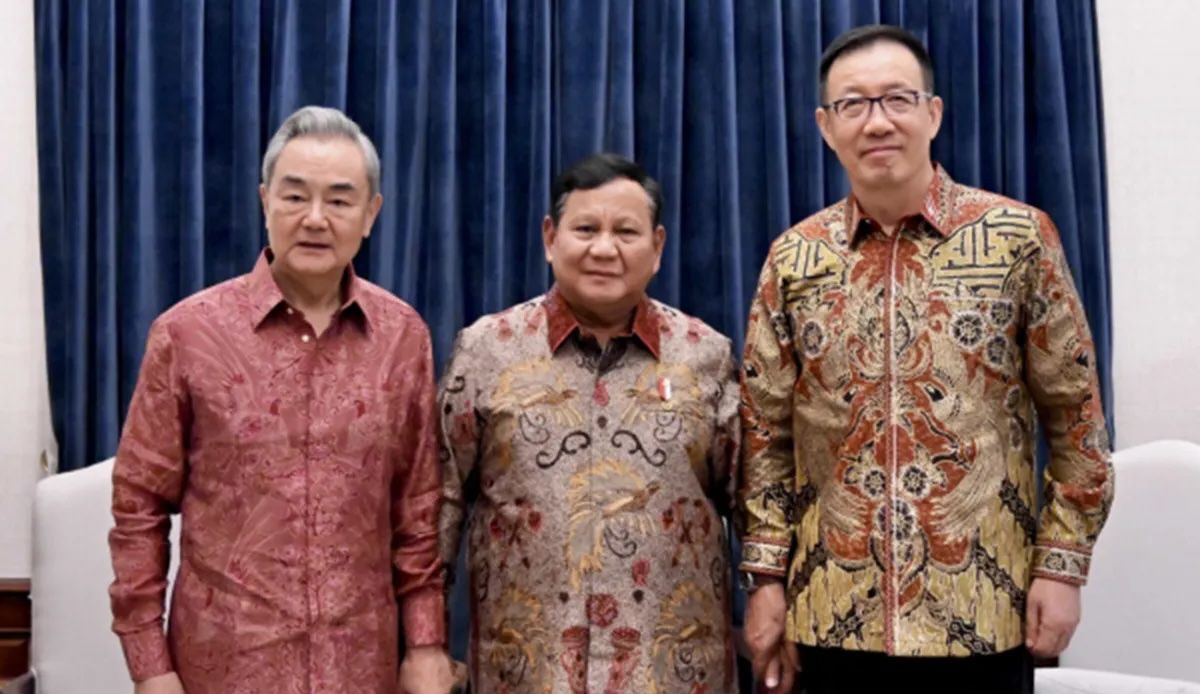
JAKARTA — The President of the Republic of Indonesia received a high-level delegation from the People’s Republic of China (PRC)—led by Chinese Foreign Minister Wang Yi and Defense Minister Dong Jun—for a courtesy call at his residence on Jalan Kertanegara, South Jakarta, on the evening of Friday, August 21, 2026.
The bilateral meeting addressed the strengthening of the comprehensive strategic partnership and regional stability, as well as the enhancement of concrete cooperation in the fields of the economy, maritime security, and defense.
This strategic meeting took place amidst the rapidly evolving geopolitical dynamics of the globe and the Indo-Pacific region. The intensive dialogue between the Head of State and the two key Beijing officials served as a crucial platform for aligning the national economic development agenda with mutually beneficial defense diplomacy.
Commenting on the meeting, the Director of Geopolitics at the GREAT Institute, Dr. Teguh Santosa, assessed that this diplomatic move reaffirms Indonesia’s consistency in implementing its “free and active” foreign policy principle. According to him, Jakarta’s openness to direct dialogue with China’s foreign policy and defense decision-makers demonstrates a mature diplomatic sovereignty.
“This meeting is a tangible manifestation of the ‘free and active’ political doctrine, adapted to the changing times. Indonesia does not limit itself from engaging in dialogue and collaboration with any major power, provided that such cooperation is grounded in mutual respect and yields real benefits for the national interest,” stated the International Relations lecturer from UIN Jakarta in a statement to the press.
Furthermore, Teguh explained that the diplomacy currently pursued by Indonesia reflects an approach of “pragmatic non-alignment.” This approach positions Indonesia not merely as a passive actor maintaining an equidistant stance from major powers, but as an active player forging flexible cooperation based on strategic needs, without the obligation of being bound by military pacts or formal alliances. “Under the paradigm of pragmatic non-alignment, Indonesia avoids becoming trapped in the dichotomous hegemonic rivalry between Washington and Beijing. We choose to engage in substantive and rational partnerships—collaborating closely with China on investment, industry, and security dialogue, while simultaneously maintaining strategic partnerships with Western nations and other regional partners,” explained Teguh.
The presence of China’s Defense Minister at the dialogue is considered to hold significant strategic weight, particularly regarding efforts to establish confidence-building measures in the region. According to Teguh, high-level defense dialogue is essential to prevent potential escalation in sensitive areas—such as the North Natuna Sea—and to ensure the stability of international shipping lanes.
From a geoeconomic perspective, this meeting reinforces Indonesia’s leverage in attracting high-quality investment that supports its industrial downstreaming and energy transformation agendas. Pragmatic diplomacy ensures that bilateral strategic projects remain aligned with the roadmap for national industrial sovereignty without compromising the independence of its foreign policy.
Teguh added that Indonesia’s diplomatic leadership—prioritizing active impartiality—also strengthens ASEAN centrality. As Southeast Asia’s largest nation, Jakarta’s success in maintaining constructive channels of communication with major powers serves as a vital anchor, preventing the region from becoming an arena for proxy conflicts between global powers.
This bilateral meeting sends a strong signal that Indonesia continues to play the role of a stabilizing power on the international stage. By combining the principles of an “independent and active” foreign policy with a strategy of pragmatic non-alignment, the government demonstrates that strategic autonomy is the most effective instrument for safeguarding sovereignty while driving economic growth in a multipolar era.[]