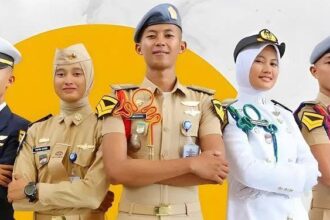

In various regions of Indonesia, Banjar men are often associated with a number of positive stereotypes. Terms such as handsome, fair-skinned, gentle, religious, and even smart at business are often heard when people talk about the Banjar people.
However, are these assumptions true? The answer is not a simple yes or no. Some have historical, anthropological, and sociological basis, but they cannot be generalized to every individual.
Who Are the Banjar People?
The Banjar people are not an ethnic group descended from a single lineage. Banjar society was formed through a long historical process.
In anthropological studies, the formation of Banjar society is known as ethnogenesis, namely the birth of a new ethnic identity through the mixing, interaction, and integration of various community groups.
The main components come from several Dayak groups in South Kalimantan, many of whom later converted to Islam and assimilated with coastal communities. Furthermore, Banjar identity is also influenced by Malay and Javanese culture, as well as trade networks that brought influences from Arabia, China, and other parts of the Indonesian archipelago.
Therefore, it is more accurate to say that Banjar is a cultural and ethnic identity formed through a long history, not simply the result of a “Dayak mix.” Banjar identity was born from this blending process.
Why Are Many Banjar Men Considered Handsome?
There is no scientific evidence to prove the existence of a “Banjar handsome gene.” However, several factors influence public perception.
1. Genetic Variation
Centuries of population mixing have resulted in a diversity of physical characteristics.
Some Banjar people have oval faces, relatively aquiline noses, a variety of eye shapes, and skin tones ranging from tan to light. This diversity is often perceived as attractive.
2. The Phenomenon of Heterosis
In genetics, there is a term known as heterosis (hybrid vigor), which refers to the condition where mixing closely related populations can increase the variation of certain traits.
However, heterosis does not automatically make someone more handsome. Physical appearance is influenced by many factors, from genetics, nutrition, health, environment, to the prevailing standards of beauty or handsomeness within a culture.
3. Cultural Perception
Standards of handsomeness are not universal.
The combination of physical characteristics of the Malay, Dayak, and other groups that make up the Banjar people creates distinctive traits that many people find attractive.
Why Are Banjar Men Known for Being Gentle?
This characteristic is more related to culture than biology.
In Banjar culture, good manners, respect for elders, being mindful of one’s words, and avoiding open conflict are highly valued values.
These values create the impression that Banjar men tend to be gentle in their behavior, although each individual’s character is certainly different.
Is Banjar Society Really Religious?
This stereotype has a strong historical basis.
Since the time of the Banjar Sultanate, Islam has been an important part of shaping the Banjar people’s identity.
South Kalimantan is also known as one of the centers of Islamic development in Indonesia, producing many great scholars, including KH Muhammad Zaini Abdul Ghani, better known as Guru Sekumpul.
Because of this, the Banjar people are often associated with a strong religious life.
Why Are Banjar Known for Their Business Skills?
The answer is inextricably linked to the history of rivers.
Before the road network developed to its present state, rivers were the main transportation routes in Kalimantan.
The Banjar people thrived as traders, river voyagers, and interregional trade hubs.
The centuries-old trading tradition fostered economic skills and negotiation skills that later became part of the Banjar people’s cultural identity.
Why Are They Known for Their Friendliness?
Cultural anthropology explains that people who make a living from trading activities generally possess excellent communication skills.
They are required to be able to build trust, establish relationships, and interact with various community groups. This factor contributes to the image of the Banjar people as friendly individuals.
Myth vs. Fact
Myth
Fact
All Banjar men are handsome
No. Handsomeness is individual and influenced by many factors.
All Banjar are of Dayak descent.
It’s not that simple. Banjar are the result of ethnogenesis involving many groups.
All Banjar are pious.
Islamic traditions are strong, but levels of religiosity vary from individual to individual.
All Banjar are gentle.
That’s a cultural stereotype, not a natural law.
All Banjar are good at business.
Trading traditions are strong, but professions are now very diverse.
Evolutionary Perspective
Why do stereotypes like “Banjar people are handsome” persist?
Social psychology shows that humans tend to remember prominent examples and then generalize them to the entire group. This is called illusory correlation.
If someone meets several attractive and friendly Banjar men, their brain may form the impression that “all Banjar men are like that,” when in reality, there is considerable variation between individuals.
Banjar men have earned a reputation for being handsome, gentle, religious, friendly, and business savvy due to a long history of ethnogenesis, population mixing, river culture, trade, and strong Islamic influence.
However, like all ethnic stereotypes, this image is a cultural predisposition and social perception, not a characteristic possessed by every Banjar person.
Banjar men are more like rivers, calm on the surface, connecting many worlds, bringing in influences from various directions, and quietly shaping civilization along their course.
References
Clifford Geertz. (1963). Agricultural Involution. University of California Press.
Banjar Sultanate. Historical sources on the formation of Banjar society.
National Research and Innovation Agency. Publications on the history and ethnography of Kalimantan.
Central Bureau of Statistics. Demographic and social data of South Kalimantan.
The Cambridge Encyclopedia of Human Evolution. Cambridge University Press.
Ethnogenesis and cultural anthropology literature on the formation of ethnic identity in Southeast Asia.
Daffa Ibrahim