BANJARMASIN — The South Kalimantan Provincial Tourism Office is stepping up efforts to improve the quality of its tourism workforce by facilitating professional competency certification for workers across the sector.
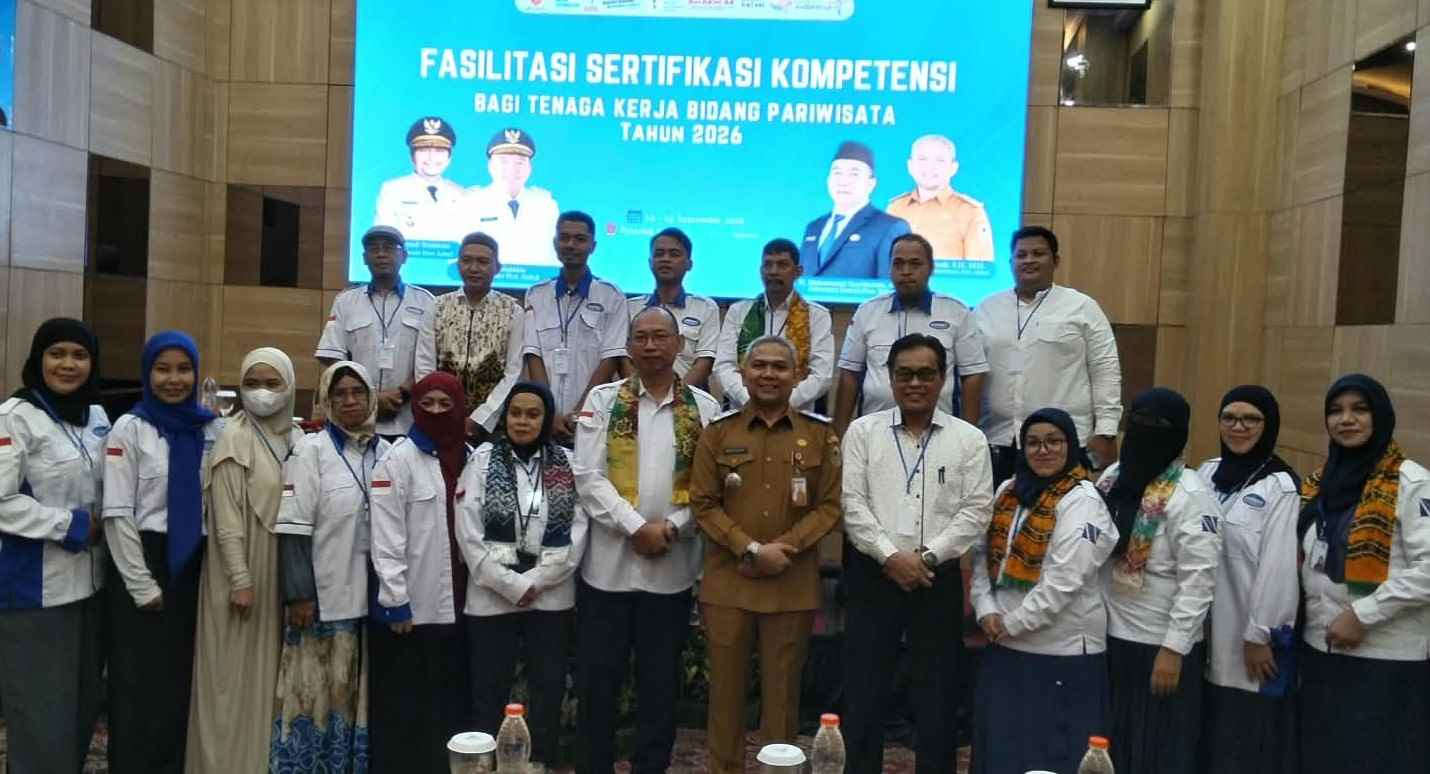
The two-day program was conducted in cooperation with the Nusantara Tourism Professional Certification Institute (LSP Pariwisata Nusantara). In the second phase of the 2026 program, 53 tourism workers took part in competency assessments, with all participants passing and being declared competent.
South Kalimantan Tourism Office Head Iwan Fitriady said the certification program was part of the provincial government’s efforts to meet the needs of the tourism industry, particularly in ensuring service standards for visitors, including international tourists.
According to Iwan, foreign tourists often require tour guides or tour leaders accompanying them to hold professional competency certificates as a guarantee of their qualifications and professionalism.
“As we know, we often hear that international tourists specifically require the tour guide or tour leader accompanying them to have a certificate, meaning that they are competent in their field. To meet this need, the South Kalimantan Tourism Office can allocate funding to facilitate professional certification for tourism workers in South Kalimantan,” Iwan said after closing the program in Banjarmasin on Tuesday (Sept. 15, 2026).
Iwan said the competency certification program had been carried out in two phases this year.
In the first phase, the Tourism Office facilitated professional certification for 47 tourism workers. In the second phase, which was recently completed, another 53 workers received support to undergo competency certification.
This brings the total number of tourism workers whose certification has been facilitated by the provincial Tourism Office in 2026 to 100.
“For these two days, this is the second phase. We facilitated 53 tourism workers in South Kalimantan to obtain professional certification. In 2026, so far, the South Kalimantan Tourism Office has facilitated certification for 100 tourism workers,” Iwan said.
He added that the second phase used a travel-services certification scheme covering three professional categories: tour guides, tour leaders and tour consultants.
“The second phase uses a travel-services scheme for tour guides, tour leaders and tour consultants. Fortunately, we were able to carry out this program in cooperation with the Nusantara Tourism Professional Certification Institute. The good news is that, according to the information I received, all participants were declared competent,” he said.
Meanwhile, Dian Putranto, chairman of the Nusantara Tourism Professional Certification Institute, said the certification process was conducted through competency assessments based on national and regional standards.
The assessment covered three key dimensions of competency: skills, knowledge and work attitude.
“Competency actually consists of three dimensions: skill, knowledge and attitude. The standards we use are based on the Indonesian National Work Competency Standards (SKKNI) and the ASEAN Toolbox. The assessment covers knowledge, skills and attitude, or work behavior. Those are the areas that were assessed during the certification process,” Dian said.
He said the application of competency standards was intended to ensure that tourism workers possessed capabilities that matched industry requirements and visitor service standards.
Dian also noted that workers certified under ASEAN-based schemes could potentially receive recognition of their competencies beyond Indonesia, including in other ASEAN countries, subject to applicable regulations.
“For some participants who use the ASEAN scheme, their competencies are recognized not only in Indonesia but also within ASEAN,” he said.
Dian said competency certification was not merely about formally recognizing workers’ abilities, but also about strengthening standardization across the tourism sector.
“The main point is that the certification we are conducting today can strengthen standardization. A standard is something that needs to be followed to achieve the level of quality expected by tourists. Ultimately, it is about visitor satisfaction, so that they are willing to return or recommend the destination to others,” Dian said.
Through improvements in workforce competency and professionalism, the certification program is expected to strengthen tourism services in South Kalimantan.
Improved service quality, in turn, is expected to enhance visitor satisfaction, encourage repeat visits and generate positive economic impacts for tourism businesses and the wider regional economy.
dilah/daffa ibrahim