JAKARTA — Leadership challenges amid disruption, uncertainty and systemic complexity have prompted a new perspective on how leaders should perceive problems and decide on appropriate courses of action.
The idea is explored in The Art of Heroic Leadership: From Systemic Blindness to Trustworthy Shared Action, a book co-authored by Zulfikar M. Rachman, also known as Coach Kangzul, and Dr. Ahmad Mukhlis Yusuf, or Coach AMY.
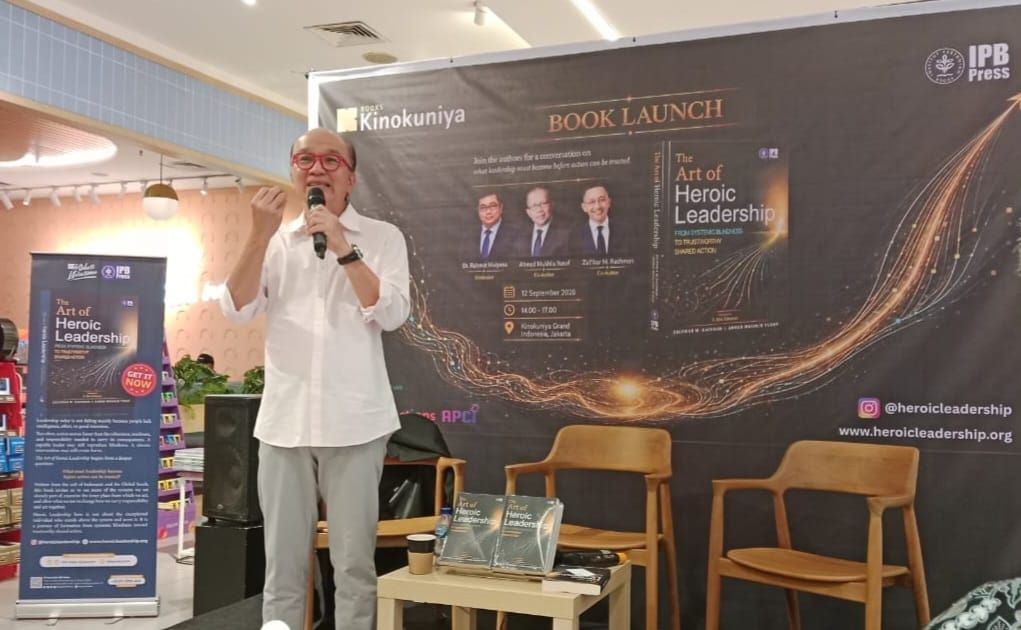
Published by IPB Press, the 324-page book was officially launched during a book launch and public discussion at Kinokuniya Book Store in Grand Indonesia, Jakarta, on Saturday (Sept. 12, 2026).
The book examines an issue that the authors say is often overlooked in modern leadership practice: systemic blindness, or the inability to see the broader dynamics and interconnectedness within a system.
According to the authors, leadership challenges do not necessarily stem from a lack of intelligence, information or data. Rather, leaders can fail to make sound decisions because they are unable to see a problem in its entirety and understand how different elements within a system are interconnected.
Dr. Ahmad Mukhlis Yusuf, an executive coach and former CEO of state news agency Antara from 2007 to 2012, said the book was born out of concerns over leadership approaches that place too much emphasis on taking action without first cultivating awareness.
“Leadership today is being tested by complexity and interdependence. We often feel that we have seen the entire problem, when in fact we have only seen a small part of it,” Coach AMY said.
For this reason, The Art of Heroic Leadership does not simply offer management techniques. Instead, it invites leaders to embark on a journey of inner awareness, develop leadership rooted in presence, and revive the value of collective wisdom through the concept of Gotong Royong 2.0.
The aim is to foster trustworthy collective action capable of creating sustainable change.
Meanwhile, Zulfikar M. Rachman, an author, Wayfinder and transformation facilitator, explained that the term “heroic” in the book’s title does not refer to a lone hero who works like Superman.
Heroic leadership, he said, begins with a leader’s courage to look inward and understand themselves.
“The hero in this book is not someone who stands outside the system to save others, but a leader who has the courage to delve into themselves, recognize their blind spots and be fully present with their team to drive meaningful change,” Coach Kangzul said.
The book also features an introductory note by C. Otto Scharmer, the originator of Theory U at MIT Sloan School of Management. Scharmer highlights the importance of leadership grounded in clarity — the ability to see and listen before taking action.
At the launch, the book’s ideas were explored through a keynote talk moderated by Dr. Rahmat Mulyana, managing partner at Strategic Action Indonesia. The discussion examined the concepts of Systems, Self and Shift, as well as the application of Heroic Leadership across various settings, from corporations and the public sector to nonprofit organizations.
The event also featured an interactive dialogue and question-and-answer session with leadership practitioners, executives and coaches. Participants were given the opportunity to join a book-signing session and network with the two authors.
Zulfikar M. Rachman is a Wayfinder, storyteller and CEO of PT Ksatria Candradimuka International. He is also the author of The Art of Heroic Coaching and actively facilitates systemic transformation processes within communities and organizations.
Dr. Ahmad Mukhlis Yusuf is an executive and business coach, academic and corporate commissioner. He served as CEO of state news agency Antara from 2007 to 2012 and is active in advancing impactful leadership, governance and waqf development in Indonesia.
Through the book, the two authors seek to convey the message that change does not always begin with a leader’s ability to “answer” a problem. Instead, it starts with the courage to look deeper, recognize blind spots, listen to different perspectives and build collective action grounded in trust.
Daffa Ibrahim